1766 – Birth of the founder
The company's founder, Johann Adolph Ibach, was born on 17 October 1766 in Beyenburg, now a district of Wuppertal.

A HERITAGE OF SOUND SINCE 1794
An IBACH is more than an instrument. It is a piece of musical history – and often part of your own.
Discover the history of your IBACHGet to know our house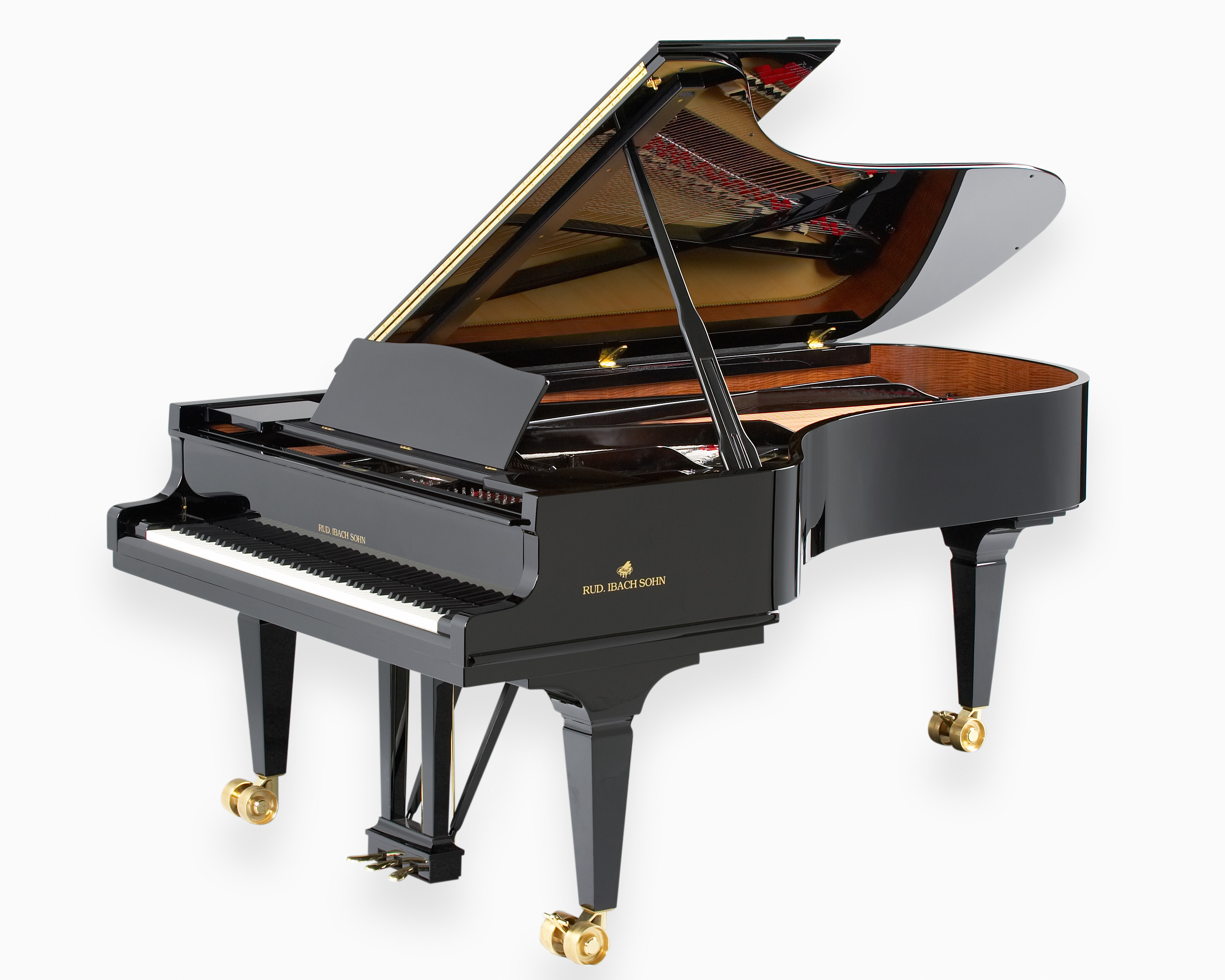
01 / THE HOUSE OF IBACH
What began in a workshop in 1794 continues to connect people, music and generations.
Johann Adolph Ibach established his organ- and piano-building workshop in Beyenburg. It grew into a family business whose instruments found homes far beyond the Bergisches Land region.
Production in Germany ended in 2007. The instruments, their stories and an exceptional archive remain. We keep this heritage alive.
Explore the milestonesTHE IBACH ARCHIVE / A JOURNEY THROUGH PICTURES
The people, instruments and ideas that shaped our house. Explore the milestones of IBACH through historical photographs and documents from our archive.
The company's founder, Johann Adolph Ibach, was born on 17 October 1766 in Beyenburg, now a district of Wuppertal.
In 1794, at the age of 28, Johann Adolph Ibach founded his piano- and organ-building workshop in Wuppertal-Beyenburg. Every member of the family worked in the business. He and his wife, Johanna Maria Christina von der Burg, had eleven children: four boys and seven girls. All four sons – C. Rudolf, Richard, Gustav Adolf and Adolf – later became piano and organ builders.
Ibach moved premises several times before finally building a business and residential property on his own land on the Allee in Barmen, now a district of Wuppertal, in 1816/17.
Carl Rudolf (1804–1863), the founder's eldest son, became a partner. His younger brothers joined in 1839 and 1844. Only Adolf Ibach, the youngest, initially remained an employee; he would establish his own organ-building business in Bonn in the 1860s. In 1839, the founder retired and handed over the company to Carl Rudolf and Richard, a gifted organ specialist. The photograph shows Carl Rudolf with his wife Regine Emilie Bruckenhaus and their sons P. A. Rudolf, Eugen and Moritz Walter, around 1860.
The founder's third son, Gustav Adolf Ibach (1815–1880), was a partner in his father's company from 1844 to 1862. A year before his elder brother Carl's death, he established his own piano factory in Barmen. It remained in business until 1898. The illustration shows the factory and adjoining shop, with the residential building on the right.
Carl Rudolf Ibach died in 1863, bringing changes to the partnership. His eldest son, P. A. Rudolf, initially managed piano production as an employee. His mother, Regine Emilie Ibach, née Bruckenhaus, continued to run the company with his uncle, the organ builder Richard Ibach, who had been a partner since 1839.
At P. A. Rudolf Ibach's initiative, organ and piano building were separated into independent businesses in 1869. Piano production continued under the name RUD. IBACH SOHN in the same building as the organ workshop for a time, until P. A. Rudolf could build a factory nearby. Europe's first concert-hall organ was the Ibach organ at the Concordia society in Barmen. This contemporary drawing shows it during a performance.
Under Richard P. Ibach (1813–1889), organ building grew remarkably, at times surpassing piano production. Several organs were built for the King of Prussia, and many were exported to neighbouring countries. When organ and piano building were separated in 1869, Richard left the partnership and took over the organ business, which became “Orgelbauanstalt Richard Ibach”. It continued until 1904.
The introduction of steam power – at Ibach in 1873 – marked the beginning of industrialisation in piano manufacturing. The photograph shows the steam engine in the boiler house in Schwelm.
At the Vienna World's Fair of 1873, the creation of distinctive designer cases became a focus of P. A. Rudolf Ibach's work. Instruments were conceived as complete works of art, bringing together craftsmanship, touch, sound and appearance. His younger brother Walter Ibach (1856–1923) worked in the company and was known as its tinkerer and inventor.
Shortly after the World's Fair, the company moved to a new factory on Neuer Weg in Wuppertal-Barmen. The horse-drawn tram and smoking factory chimneys were signs of the modern age and the use of machinery. The photograph shows the factory around 1890.
Richard Wagner (1813–1883) composed parts of “Parsifal” in Naples during the winter of 1879/80 on IBACH grand piano no. 7,000, now in Bayreuth. In one of his letters, Wagner called Rudolf Ibach his “friendly helper in sound”.
Alongside industrialisation, P. A. Rudolf Ibach played a major role in the development of designer instruments. In 1883 he invited architects and artists to submit tasteful, contemporary designs for instrument cases in the world's first design competition for musical instruments. First prize went to Bruno Schmitz, later the architect of Leipzig's Monument to the Battle of the Nations. His lavish case reflected the taste of the period, although to modern eyes it is rather reminiscent of a coffin.
The factory in Schwelm opened as a second production site in 1884. Following the destruction and losses of the Second World War, it became the company's headquarters and sole production site in 1945, despite having suffered damage itself. Jakob Weeser-Krell's 1887 illustration shows Wilhelmstrasse and the recently acquired second factory.
P. A. Rudolf died in 1892 while taking a spa cure, aged just 49. His widow, Hulda Ibach, née Reyscher (1845–1921), successfully ran the company for the next twelve years. She expanded the business and was able to hand it over to her sons in excellent shape in 1904.
Under Hulda Ibach's leadership, the company celebrated its centenary in 1894. Bruno Schmitz designed anniversary grand piano no. 25,000, now at the music academy in Munich. Alongside everyday instruments, many artistically designed uprights and grands were made during this period, and the Berlin sales branch expanded into a third factory. In addition to Western Europe, IBACH had a strong presence in Central and South America, the Baltic states and Russia. Its instruments also found customers in Asia, Africa and Oceania. With support from Hulda's brother-in-law Walter Ibach, numerous inventions and improvements were introduced then and later: the transposing grand piano (Kraus/Ibach patent), the curved keyboard (Clutsam patent), the radiating keyboard (Schulz/Ibach patent), the Ibachord concert harpsichord, the conductor's-desk piano, the Jankó keyboard (Jankó patent), the Ibachiola, and the Ibach-Welte grand and upright pianos.
The fourth generation entered the company in 1904 when Albert Rudolf Ibach (1873–1941) became a partner. He was married to Elisabeth, known as Lilli, Wolters. His younger brothers Max (1875–1915) and Hans (1877–1913) also became partners in 1904. The established business strategy continued, relationships with artists expanded, and the company built its own concert halls in Düsseldorf, Berlin and Cologne. The First World War and its aftermath dealt severe blows to piano makers. German piano exports lost markets in America and Russia, while radio and the gramophone led many potential customers to forgo making music themselves. The economic crisis of the late 1920s brought a wave of factory closures that spared neither small nor large manufacturers. Though badly bruised, IBACH survived these difficult years as a viable business.
A long and close friendship connected the Ibach family with Richard Strauss (1864–1949). In 1926 he granted RUD. IBACH SOHN the right to name its F-III 215 grand piano range after him. This reflected both their friendship and their close collaboration. Strauss owned an IBACH designed for him by Emanuel von Seidl.
Adolf Ibach (1911–1999) joined the company in 1933. In 1938 he developed a compact upright piano just one metre high, responding to changing housing conditions and customer preferences. The head of the family firm died in 1941, as did Adolf's elder brother, Dr Alfred Rudolf (Rolf) Ibach (1909–1941). At the same time Adolf, now head of the company, was called up for military service. The photograph shows him with his eldest daughter Brigitte Brauneis (born 1938) and the compact piano he developed.
Rebuilding after 1945 was difficult: the devastation of the Second World War had also brought major losses to IBACH. The original headquarters in Barmen had to be abandoned. Urban planning prevented reconstruction in Wuppertal, so the Schwelm branch factory became the headquarters. With great effort, production resumed in the early 1950s. Before that, the business restarted with repairs while the factory buildings were restored. The 1949 photograph shows the IBACH stand at the AFO reconstruction and progress fair, held in a tented exhibition area on the Döppersberg in Wuppertal-Elberfeld.
IBACH produced its 100,000th instrument in 1956. During this period of renewal and growth after the Second World War, the company was led by Adolf Ibach and his wife Margrit, née Amann (1914–1995). Adolf continued to expand production, now based exclusively in Schwelm.
As the 150th anniversary could not be celebrated in 1944, the 175th anniversary was special in many ways. It also marked a high point in the era of Adolf and Margrit Ibach, the fifth generation. In the same year, Rolf Ibach became a partner, representing the sixth generation. The photograph shows members of the workforce during the anniversary year.
Instrument no. 125,000 was completed in 1973. The makers of the grand piano were Peter Räupke (kneeling in front) and, from left, Dieter, Stute, Bruno Dötsch, Klaus Henkel, Werner Böhme and Hans Köbleert.
Rolf Ibach (born 1940) took over the company in the 1980s as its sixth-generation leader. The acquisition of piano production from Roth & Junius gave rise to a multi-brand strategy. The photograph shows Margrit and Adolf Ibach with their two sons, Rudolf Christian (born 1937) and Rolf.
The company's bicentenary was celebrated in 1994 both in Wuppertal, its birthplace, and at the Cologne Philharmonie. The highlight was a gala evening at Wuppertal Opera House. The then Minister-President of North Rhine-Westphalia, Johannes Rau, himself a native of Wuppertal, gave the ceremonial address.
Following his great-grandfather's tradition, Rolf Ibach decided to revive the idea of designer instruments for the company's bicentenary. This led to a collaboration with the American architect and Pritzker Prize winner Richard Meier (born 1934). The grand piano was unveiled in 1997. The photograph shows, from left, Rolf Ibach, Richard Meier, Rudolf Christian Ibach and Christian Sabisch presenting the designs and model at the IBACH premises in Schwelm.
In 2004 Sabine Ibach joined the company as managing director, representing the seventh generation. From 2006 she was the sole shareholder. The photograph was taken during a visit by former Bundestag President Wolfgang Thierse in 2005.
In the company's 213th year, production of upright and grand pianos in Schwelm ceased on 31 December 2007.
The IBACH Archive connects the heritage of the manufactory with those who own, play or research an IBACH instrument today.
Explore the archive service02 / INSTRUMENTS & DESIGN
From concert grands to family-owned uprights, IBACH brings sound and design together. Collaboration with artists and architects is part of the company's history.
Instruments that have found their place on concert stages and in people's musical lives.
IBACH AND ITS SPECIAL MODELS
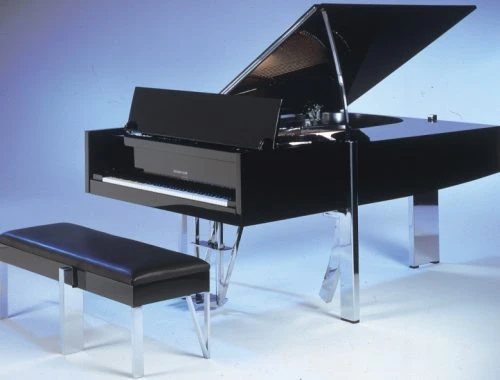
Instruments designed by architects and artists – from Peter Behrens and Bruno Paul to Richard Meier.
Discover the special modelsARCHITECTURE, ART AND PIANO BUILDING
Instruments designed by architects and artists
When Richard Meier began designing his IBACH grand piano in 1995, work also began in Schwelm on systematically cataloguing the family and company documents. The development of the archive revealed the remarkable variety of IBACH's collaborations with visual artists and architects since the second half of the nineteenth century.
Architects combined artistic ambition with an understanding of function and use. IBACH embraced different styles and developed special models alongside its regular production, as one-off pieces, small editions and series. Their heyday was between 1873 and 1914, although their origins reach back to the earliest World's Fairs from 1851 onwards.
Designs came from well-known and lesser-known artists, decorative arts workshops and the company's own staff. In-house designers included the woodcarver Frielinghaus and the architect Winkler, who worked at IBACH from 1906 to 1930.
Albin Müller (1871–1943) also lived in the Mathildenhöhe artists' colony. A special gilded version of his grand piano design was made for the Grand Duke of Hesse-Darmstadt.
Wilhelm Kreis designed this angular rosewood grand piano with doors covering the keyboard. It features rich inlay work and a lid decorated in marquetry. It was presented in Dresden in 1906.
Patriz Huber (1878–1902), another resident of the Darmstadt artists' colony, designed the “grand piano in grey” for the renowned publisher Alexander Koch (instrument no. 41,645). Made of maple, it matched the other furnishings in the publisher's home.
The sculptor Franz Metzner (1870–1919) created two reliefs for this piano: “Children Playing” on the left and “Old Man with Youth” on the right.
A distinctive IBACH creation was the symmetrical Model 42 grand piano, known as the “bell-shaped grand” because of its outline. It was produced in the 1880s and again in the early twentieth century.
This bell-shaped grand for Hans Ibach was made in walnut with gilded carvings. Its Louis XVI-style design came from Bembé.
The German architect, designer and university professor Hermann Billing (1867–1946) designed this symmetrical Art Nouveau grand in oak, with a grey-blue finish and inlays (instrument no. 45,501). He also designed an IBACH music room for the 1904 World's Fair in St Louis. The grand piano won a Grand Prix and was sold to the Grand Hotel in Gardone Riviera in 1906.
Bembé's design for the IBACH “English style” upright dates from 1900.
Max Ibach was married to Selma Preetorius. After August Bembé's death in 1880, the merchant Wilhelm Preetorius, who had only recently become a partner, became the sole owner. His daughter Selma was Max Ibach's wife.
Peter Behrens designed an upright and a grand piano for IBACH in 1904/1905. Concert grand no. 50,827, Model 14a, was sent to Dresden in 1906, where it won an award at the Third German Decorative Arts Exhibition.
The Model 40 grand in lemonwood, designed by Bembé of Mainz, was made for the Krupp family in 1905. The photograph shows it in the music room at Villa Hügel in Essen.
Grand piano no. 49,998, in the Adam style, was made in rosewood with genuine bronze fittings. Another Bembé design, it was built for August Thyssen in 1907. The photograph shows the IBACH piano in the family's drawing room at Schloss Landsberg in Essen-Kettwig.
In 1995, immediately after the company's bicentenary, the American architect and Pritzker Prize winner Richard Meier (born 1934) began designing his grand piano. The design was realised in 1997, based on the F-III 215-TH. That same year, instrument no. 148,900 was unveiled to the public.
Peter Behrens's original upright design was created around the same time as his grand piano design, in late 1904 or early 1905. The upright was produced in several versions and reissued for the company's bicentenary.
At least one original is known to survive: upright no. 48,068, held in a private collection in Germany. In early 2018 it received particular attention in the exhibition “#alleskönner. Peter Behrens at 150” at the Museum of Applied Arts in Cologne.
Bruno Paul's (1874–1968) collaboration with IBACH coincided with his work on interiors for four luxury liners of Norddeutscher Lloyd. For the 1908 liner “Prinz Friedrich Wilhelm”, whose artistic interiors he designed, IBACH built the grand piano for the main lounge. The dining-room upright was also made to his designs. It is not known whether instrument no. 72,231, the forerunner of the later C-118 Edition, was intended for an elegant private home or originally for a ship. After its completion in 1911, it was sold to Darmstadt, then a centre of the arts.
The design was reissued in 1994 in four polished finishes, with or without inlays: black, white, cherry and mahogany.
ANOTHER CHAPTER IN IBACH'S HISTORY
We do not know which was the first church organ built by the founder, Johann Adolph Ibach. Records from the company's early years are very incomplete. We do know, however, that in the year after the business was established, J. A. Ibach extensively renovated the organ at the monastery of the Order of the Holy Cross in Beyenburg, now part of Wuppertal.
We also know that J. A. Ibach built small and domestic organs in the company's early years, for which there was a good market in the devout Wupper valley. Repairs to church organs are also documented. Larger instruments can only be traced from the time his sons joined the business. His second-eldest son, Richard Ibach, particularly distinguished himself in this field.
By the middle of the nineteenth century, organ building had overtaken piano production within the company. IBACH organs were sold not only to the German states but also elsewhere in Europe and overseas. The organ boom did not subside until the 1870s, when piano building regained first place at IBACH.
By then, organ and piano building had already been separated organisationally. Having previously operated under one roof, the business was divided in 1869 into an independent piano manufacturer and a separate organ-building company.
03 / YOUR INSTRUMENT HAS A STORY
When was your IBACH first delivered? Who was it built for? And what was its original specification?
Our historical ledgers may reveal the earliest stages in your instrument's life. The extent of the information depends on the surviving entries.
YOUR ENQUIRY IN THREE STEPS
It is often located on the cast-iron frame or the soundboard.
Have photographs ready showing the whole instrument, its number and any distinctive details.
Describe your instrument and what you would like to learn about it.
Your details will initially only be used to prepare an email.
GOOD TO KNOW
Depending on the entry, it may be possible to establish the first delivery date, model, specification, first purchaser or dealer, and original price. Not every detail survives for every instrument.
Its current value depends largely on its condition. An assessment on site by a qualified piano specialist is required. An archive report does not replace a valuation.
The ledgers mainly record the first delivery. Later sales and changes of ownership generally cannot be traced through these records.
The company and family archive comprises almost 190 linear metres of material. For academic enquiries, please write to archiv@ibach.de and describe your project.
LET'S STAY IN TOUCH